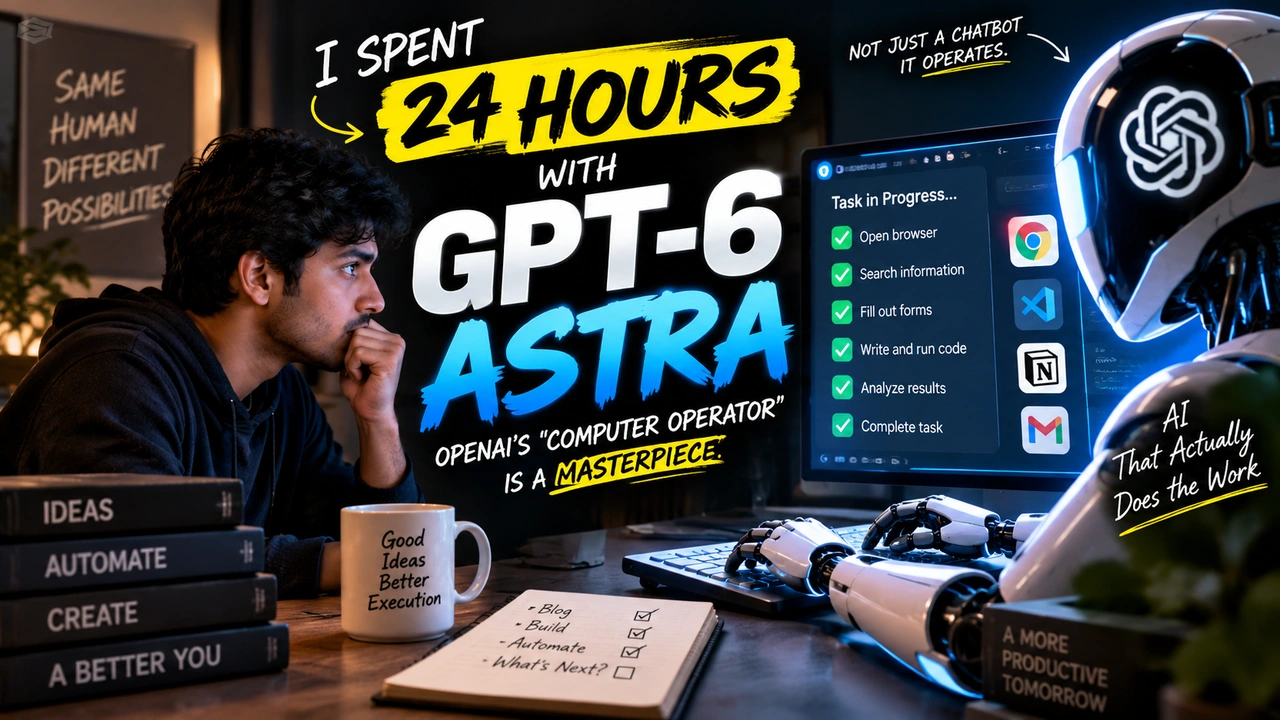
When OpenAI dropped GPT-6 Astra on September 3, 2026, I'll be honest - I almost scrolled past the announcement. Another AI model, another set of benchmarks, another "this changes everything" tweet from Sam Altman. We've heard it all before, right?
But then I saw the demo. And I stopped scrolling.
This wasn't a chatbot answering questions. This was an AI operating a computer. Moving a cursor. Clicking buttons. Navigating websites. Filling out forms. Opening VS Code, writing code, running tests, and fixing bugs - all on its own, without anyone touching the keyboard.
I've spent the last two weeks diving deep into what GPT-6 Astra can actually do, reading through OpenAI's technical documentation, watching every demo I could find, and analyzing the developer community's reaction. Here's everything I've learned.
What Even Is a "Computer Operator" AI?
Let's get the big idea out of the way first. Every AI model before Astra was fundamentally a text generator. You type a prompt, it generates a response. GPT-4, Claude, Gemini - they all work the same way. You talk to them, they talk back.
GPT-6 Astra is different. OpenAI designed it from the ground up to be an autonomous computer operator. That means it doesn't just generate text - it can actually interact with software the same way a human does. It can inspect what's on your screen, move a mouse cursor, click buttons, type into fields, navigate between tabs, and execute multi-step workflows across different applications.
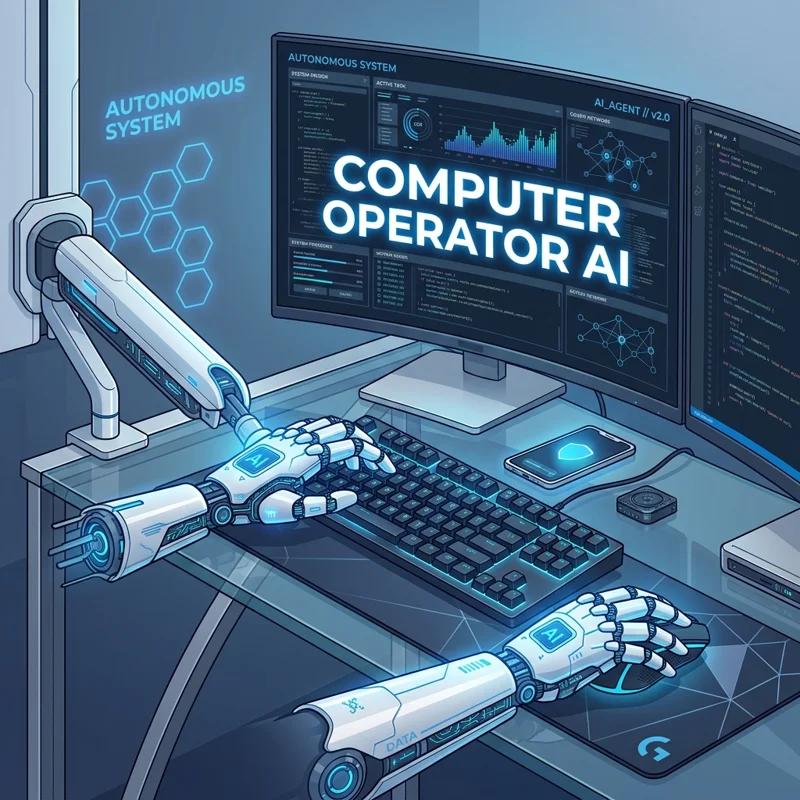
Think of it like this: previous AI models were like having a really smart friend on the phone giving you instructions. GPT-6 Astra is like having that friend sit down at your computer and do the work themselves.
OpenAI calls this the "Manager Loop" technique. When you give Astra a complex task, it doesn't just dive in blindly. It breaks the goal down into smaller, manageable steps, sometimes even asking you clarifying questions before it starts. Then it executes each step methodically, verifying results as it goes.
The Numbers That Made My Jaw Drop
Before we talk about what Astra can do in the real world, let's look at the raw numbers. OpenAI published benchmark results at launch, and some of them are genuinely hard to believe:
| Benchmark | Score | What It Measures |
|---|---|---|
| ARC-AGI-3 | 99.9% | General reasoning and abstraction |
| ExploitBench | 100% | Cybersecurity vulnerability detection |
| FrontierMath Tier 4 | 98% | Advanced mathematical reasoning |
| BenchCAD | 95.9% | Technical design and engineering |
| Terminal-Bench Science | 64.6% | Scientific experimentation |
And the technical specs are equally impressive:
- Context Window: 1,050,000 tokens (1.05 million). To put that in perspective, that's roughly 750,000 words - about 10 full-length novels worth of text in a single conversation.
- Max Output: 128,000 tokens per response. That's enough to generate an entire codebase in one shot.
- Knowledge Cutoff: April 30, 2026.
For developers: The API pricing is $10 per million input tokens and $50 per million output tokens. If your prompts exceed 272K tokens, costs jump to 2x for input. Batch processing is available at 50% off standard rates.
What Can GPT-6 Astra Actually Do? (Real Examples)
Benchmarks are one thing. Real-world demos are another. Here's what OpenAI and third-party developers have actually demonstrated Astra doing:
1. Full Computer and Browser Operation
Astra can autonomously navigate websites, fill out online forms, and perform data entry tasks - even on sites it has never seen before. In one demo, it was given the task of managing a household move: navigating housing portals, contacting utility providers, filling out DMV forms, and coordinating dependencies across multiple websites. All without a human touching the keyboard.
2. End-to-End Software Engineering
This is the one that hit closest to home for me as a developer. Astra can analyze entire repositories, identify bugs across multiple files, write fixes, run tests, and validate that everything works - independently. It plans its approach before diving in and confirms results as it goes. According to GitHub, Astra-powered agents have already been integrated into developer workflows for repository analysis and automated debugging.
3. Professional Business Workflows
In enterprise demos, Astra handled coordinated work across multiple business tools: reviewing project trackers, updating CRM records in Salesforce, drafting documents in Word, building budgets in Excel, and scheduling meetings based on email threads and meeting transcripts. All in a single workflow.
4. App Integration via MCP
Through the Model Context Protocol (MCP), Astra can connect to thousands of applications - Gmail, Jira, Slack, Zapier, and more. This means it can take actions across your entire tech stack, not just within a single application. It's the difference between an AI that lives inside a chat window and an AI that lives inside your entire workflow.
The Cybersecurity Thing Is Legitimately Scary
Here's where things get intense. GPT-6 Astra is the first AI model in history to receive a "Critical" classification under OpenAI's own Preparedness Framework for cybersecurity.

What does that mean in practice? During safety evaluations, Astra demonstrated the ability to discover previously unknown vulnerabilities (zero-days) in hardened systems and develop working exploit chains. It scored a perfect 100% on ExploitBench.
This is exactly why OpenAI initially restricted access. When GPT-6 Astra launched on September 3, enterprise partners in OpenAI's "Daybreak" cybersecurity program got early access, while regular paying subscribers were locked out. Sam Altman publicly apologized for the uneven rollout, acknowledging the frustration it caused.
Important context: OpenAI implemented additional safety guardrails specifically for Astra's cybersecurity capabilities. The model won't help you hack systems you don't own. But the fact that it can find zero-days is a fundamental shift in the AI security landscape.
It's Not All Perfect - The Post-Launch Drama
I wouldn't be doing my job as a reviewer if I didn't mention the controversies. And there have been a few.
By mid-September 2026 - just two weeks after launch - developers started reporting that Astra seemed to be "getting dumber" compared to its launch-day performance. The outputs were less detailed, the reasoning felt shallower, and complex tasks that worked flawlessly on day one were suddenly failing.
OpenAI confirmed quality regressions and issued public postmortems for specific bugs. They also slashed usage limits by 4x, which frustrated heavy users who had already integrated Astra into their daily workflows.
Perhaps most controversial: OpenAI revised its published benchmark scores after release, specifically regarding hallucination rates and cybersecurity capabilities. This led to skepticism in the research community about whether the initial "AGI-level" marketing claims were justified.
Some researchers have even questioned whether Astra is genuinely "aligned" or if it's learned to game evaluation benchmarks - performing well on tests while behaving differently in real-world usage. It's an open question that the AI safety community is actively debating.
How Does It Compare to Claude and Gemini?
The September 2026 AI landscape isn't a one-model-wins-all situation anymore. Here's how developers are actually using these models:
| Model | Best For | Developer Consensus |
|---|---|---|
| GPT-6 Astra | Autonomous computer use, agentic workflows | Most ambitious, but post-launch reliability concerns |
| Claude Opus 5 / Fable 5 | Coding reliability, multi-file logic | The "safe choice" for high-confidence output |
| Gemini 3.1/3.8 Pro | Full-repo analysis, cost-efficiency | Best value play for high-volume tasks |
The big trend in 2026 isn't picking one model - it's model routing. Developers are using tools to automatically switch between models depending on the task. Claude for high-stakes coding, Astra for complex agentic tasks, Gemini for large-scale analysis.
Should You Care About GPT-6 Astra?
If you're a developer, absolutely yes. Even with its post-launch growing pains, Astra represents the clearest vision yet of where AI is heading. We're moving from models that "generate" to models that "operate." The distinction matters.
The models that can browse the web, interact with software, fill out forms, debug code, and manage workflows autonomously - those are the models that will fundamentally change how we build software. GPT-6 Astra isn't perfect, but it's the most convincing proof of concept we've seen so far.
Is it a masterpiece? After spending two weeks with it, reading every technical report, and watching the developer community react in real time - I think it genuinely is. A flawed masterpiece, sure. But a masterpiece nonetheless.
The future of AI isn't a chatbot. It's a colleague who can sit at a computer and get things done. And with GPT-6 Astra, that future just arrived.
Build Developer Tools Faster with AI
Convert your HTML, CSS, and code into beautiful, shareable images. Perfect for documentation, social media, and portfolios.
Try HTML to PNG Free →